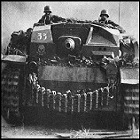
Some back ground information of the the Großdeutschland division.
-----------------------------------------------------------------------------------
History
The unit originally started out as a ceremonial guard unit in the 1920s and by the late 1930s had grown into a regiment of the German Army. The regiment would later be expanded and renamed Infantry Division Großdeutschland in 1942, and after significant reorganization was renamed Panzergrenadier Division Großdeutschland in May 1943. And later in November 1944, while the division retained its status as a panzergrenadier division, some of its subordinate units were expanded to divisional status, and the whole group of divisions were reorganized as Panzerkorps Großdeutschland.
Early history
The roots of the unit go back to 1921 when the guard unit of the city of Berlin (Wachregiment Berlin) was created. The unit was used for ceremonial and representative duties such as parades and guard duties in the capital. The unit was later reformed as Kommando der Wachtruppe. The unit grew in size, function and responsibility throughout the 1930s. In the first week of 1939, Hitler ordered that the unit be renamed Infanterie-Regiment Großdeutschland. The unit was now a permanent cadre, and unlike other regiments of the German Army (which were raised from a particular region), the recruits of the Großdeutschland were to be drawn from across the nation. The unit was officially activated on 14 June 1939, and the occasion was marked by a parade through the streets of the capital.
The regiment saw action in France in 1940. It was attached to Panzer Group 2 in the opening phases of Barbarossa, and was nearly annihilated in the vicious fighting outside of Moscow in late 1941. On the last day of February 1942, Rifle Battalion Großdeutschland (all that was left of the original regiment) was disbanded and two battalions formed a new Großdeutschland Regiment out of reinforcements arriving from Neuruppin. The Regiment later moved to Orel after, and on 1 Apr 1942, arising out of the need for new motorized formations for the summer offensives of 1942, an announcement was made at a regimental parade at Rjetschiza: "Effective immediately, the former Infantry Regiment Großdeutschland is expanded to the Infantry Division Großdeutschland.
While resting and refitting near Orel, the Infantry Regiment Großdeutschland reorganized and expanded to become Infanterie-Division Großdeutschland (mot.). The existing Regiment became Infanterie-Regiment Großdeutschland 1, and was joined by the newly formed Infanterie-Regiment Großdeutschland 2. Supporting units in the form of a Panzer battalion, an assault gun battalion and increased flak, artillery and engineers were added with the upgrade to divisional status.
After the reorganization, the Großdeutschland Division was assigned to XLVIII. Panzerkorps during the opening phases of Fall Blau, the assault on Stalingrad. The division took part in the successful attacks to cross the upper Don river and to capture Voronezh. In August, the division was pulled back to the north bank of the Donets and held as a mobile reserve and fire-brigade counterattack force. During the combined Soviet winter offensives Operation Uranus and Operation Mars, the Division was involved in heavy winter fighting near Rzhev. The Division sustained heavy losses in the Rzhev salient, effectively making the division combat ineffective. It was pulled out of the lines and refitted.
In January–February 1943, Großdeutschland and XLVIII.Panzerkorps, along with the II SS Panzer Corps took part in the Third Battle of Kharkov. The division fought alongside the 1.SS Division Leibstandarte SS Adolf Hitler, 2.SS Division Das Reich and 3.SS Division Totenkopf during these battles. After the fall of Kharkov, the Großdeutschland was again pulled back and refitted.
Panzer Grenadier Division Großdeutschland
In May 1943, with the addition of armoured personnel carriers and Tigers the division was redesignated Panzer Grenadier Division Grosdeutschland, though in reality it now had more armoured vehicles than most full strength panzer divisions.
Operation Citadel
The newly re-equipped division was subordinated to the XLVIII Panzer Corps (which is part of Fourth Panzer Army commanded by Hermann Hoth), and was to play a major role alongside the II SS Panzer Corps in Operation Citadel - the German offensive to sever the Kursk salient. During the buildup period, a brigade of two battalions equipped with the new tanks, Panther Ausf. D, was integrated into the OOB of Großdeutschland Division. After the launch of Operation Citadel, the division was heavily engaged in the fight to penetrate the southern shoulder of the salient. The new Panthers were plagued by technical problems, suffering from engine fires and mechanical breakdowns, with many becoming disabled before reaching the battlefield. The Großdeutschland Division did not take part in the tank battle of Prokhorovka, and the Panther tanks were not engaged as most were broken down by the time the battle started. The division fought on until it was pulled back to Tomarovka on 18 July 1943.
After the Kursk offensive was cancelled, the division was transferred back to Heeresgruppe Mitte, and resumed its role as mobile reserve. The Tiger tank company was expanded to an entire battalion, becoming the III. Battalion of the Panzer Regiment. Großdeutschland saw heavy fighting around Karachev before being transferred back to XLVIII Panzer Corps in late August. For the rest of 1943, Großdeutschland was engaged in the fighting withdrawal from the eastern Ukraine, taking part in battles around Kharkov, Belgorod, and finally on the Dnieper, ending the year fighting strong enemy forces near Michurin-Rog, east of Krivoi-Rog. It was during this period that the division earned the nickname die Feuerwehr (The Fire Brigade).
Großdeutschland continued fighting in the area of Krivoi-Rog early in January 1944 until it was transferred west for rest and refit. During this period, 1./Panzer Regiment 26 (Panther) joined the Panzer Regiment Großdeutschland, and Großdeutschland's I. Bataillon moved to France to refit and train with the new tanks; they did not rejoin the Division until after the Normandy invasion.
Over the next months, the division continued moving from crisis-point to crisis-point across the front. Panzer Regiment Großdeutschland saw action in the battles to relieve the Cherkassy pocket in late January 1944 while the rest of the division was involved in heavy fighting from the Dniester to Northern Bessarabia. On 4 March 1944 the First, Second and Third Ukrainian Fronts launched a major attack on the north, central and southern flanks of Army Group South, and Großdeutschland moved to Kirovgrad, bolstering weak parts of the line until withdrawn to Rovnoye to the southwest. On 16 March the division began the move to the Dniester River, and by the end of March had entered Romania.
In April 1944, Großdeutschland. as a part of LVII.Panzerkorps. fought defensive battles near Iaşi, including the First Battle of Târgu Frumos, slowly retreating to Târgul Frumos in Moldavia. Fighting in the region raged for over a month. A renewed Soviet offensive began on 2 May, aimed at breaking through Großdeutschland and onto the Romanian oil fields. The defensive action at the Second Battle of Târgu Frumos was the focus of several NATO studies during the Cold War.
In mid May, the infantry and reconnaissance components of the division were equipped with armored personnel carriers (Schützenpanzerwagen) and other armoured vehicles. The Füsilier regiments were downsized from four battalions to three. The division was then sent back to the front, where it was involved in the fighting around Podul Iloaiei. After a brief rest in early July, the division was again committed to heavy fighting in northern Romania.
In late July, the division was transferred to East Prussia. Over the next months, Großdeutschland was involved in heavy fighting in both East Prussia, including a successful counter-attack on Wilkowischken and the Baltic States, suffering large casualties in both men and material. The division was nearly annihilated during the battles in the Memel bridgehead.
Panzer Corps Großdeutschland
In November 1944, while the division retained its status as a Panzergrenadier division, several attached units were expanded to divisional status, and the Panzerkorps Großdeutschland was formed.
The Corps was made up of primarily two Divisions - Großdeutschland and the Brandenburg Division which have its origins strongly linked to the Großdeutschland.
By March 1945, the Panzer Grenadier Division Großdeutschland had been reduced to around 4,000 men. These escaped by ferry from the collapsing Memel bridgehead. They landed at Pillau and were put straight back into combat. By 25 April 1945, the division ceased to exist, having been completely destroyed in the battles around Pillau. Of the survivors only a few hundred were able to make their way to Schleswig-Holstein and surrendered to British forces. The majority of the men were left behind and were forced to surrender to the Russians where they often faced death or an indefinite amount of time in Soviet labor camps.
Panzer Grenadier Division Kurmark had been created out of Großdeutschland remnants in early 1945 and had fought throughout the last months of the war. Men of both the Brandenburg and Kurmark units were entitled to wear Großdeutschland insignia.
---------------------------------------------------------------------------------------------
Now on to the Plastic!!


Kit decals, I will probably not be using these.

For my Diorama I picked up some East Prussian Grenadiers. I'm going to enjoy painting the camo for these guys.


I also ordered some aftermarket decals from Bison...


And a color picture of the paint scheme from the Bison website.

Cheers!!
GG